Yang Family Long Form
There are three videos that may help you in learning the Tai Chi form. Here we identify 'posture' as a fixed physical body shape or pose, 'movement' between each pose and 'sequence' as the order in which each pose is made.
The Form
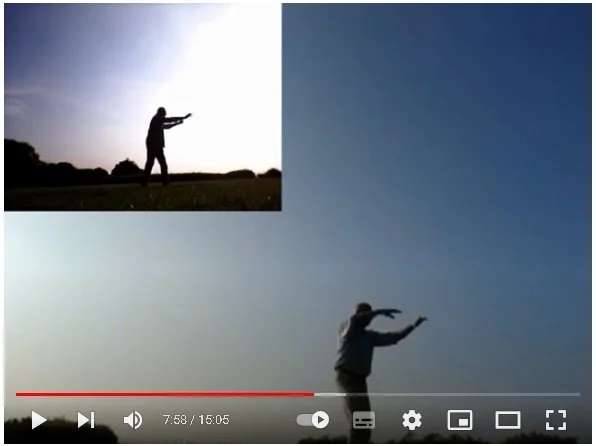
A simple video that takes you through the sequence of postures.
This provides an overview of the flow and sequence of movement. The camera view is fixed in order to get a feel for the orientation and direction on each posture.
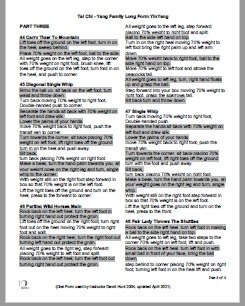
An accompanying booklet will provide a list of the postures. The traditional names used in the forms sequence are used in each heading. A mixture of traditional names and Embodied Tai Chi descriptive names are then used for each posture. Each movement is further identified for advanced students as it relates to either a yin or yang phase of each posture.
Long Form
The Audio Form
This video includes an audio talk through of the form using the terminology adopted during Embodied Tai Chi classes.
The video comprises of various camera angles providing a clearer view of each posture. The audio element is perhaps the most helpful part for those people learning the form. Practice what you have learned by simply listening to the audio as a prompt for each movement. In this way it is possible to focus on both the intention and sensation of movement instead of turning the head and being distracted by looking at the video screen.
Long Form Audio
The Sequence Form
The video has broken down the postures and movements into distinct sequences.
The video provides an overview of the form naming each sequences as they first appear. When a sequence is repeated the video is speeded up and the name at the bottom of the screen disappears. This video breaks down the seemingly random and complex postures of the form into blocks of movement that can be repeated. While perhaps helpful with an intellectual undertaking of the Tai Chi form please bear in mind that the real aim is to develop a more sensation based 'muscle memory' style of practice. The sequence videos are more helpful for the longer forms that contain a greater number of repeated sequences.
Long Form Sequence