Finding Your Own Pace - Chuang Tzu, Perception and a Labyrinth
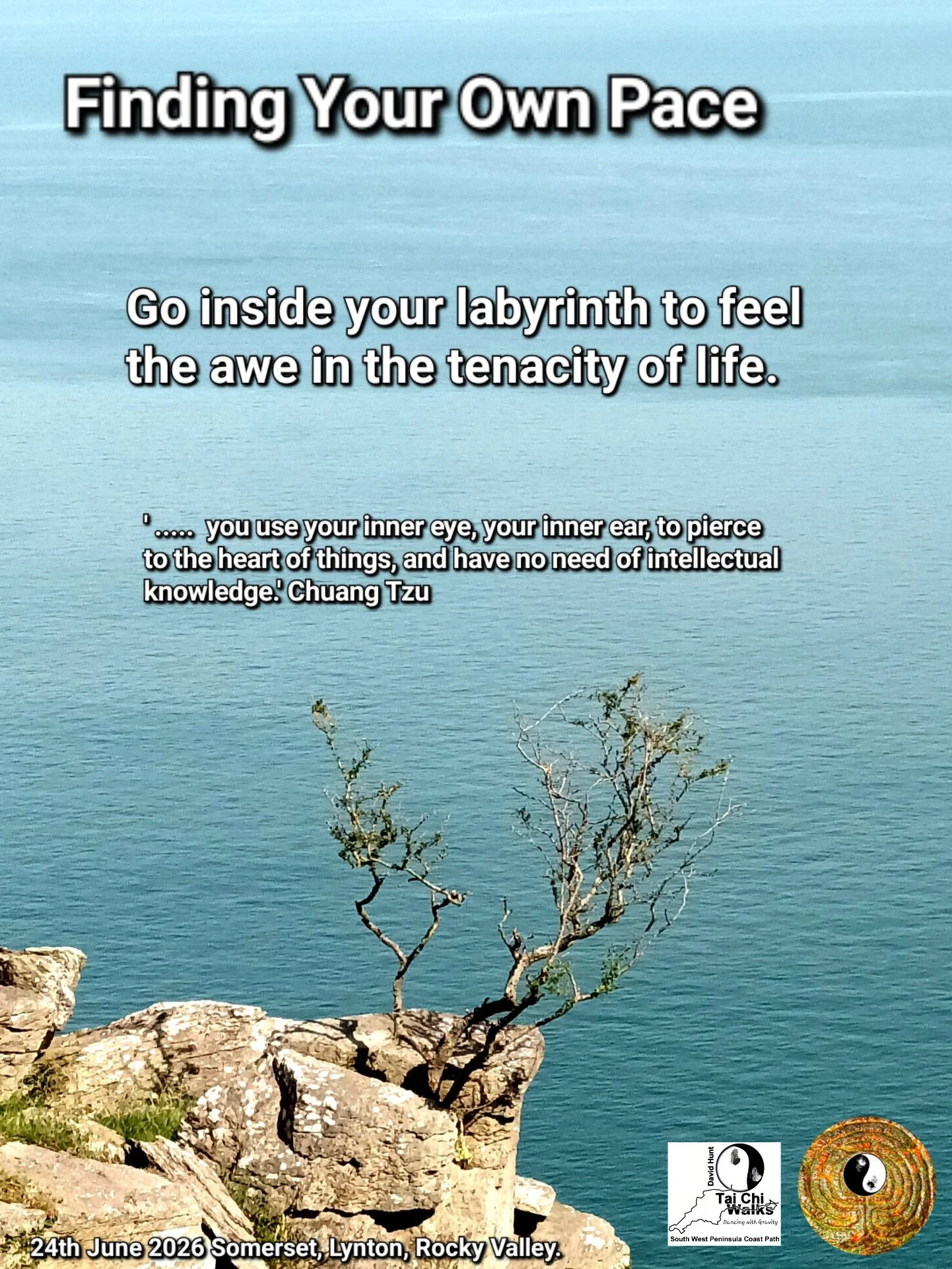
When we pay attention towards the way we walk something changes. Our mental focus is distracted from preoccupations, worry or other external demands. Instead we tune into the internal body sensations from our muscles, tendons or facia as we move. This simple act takes us on an interoceptive, somatic, embodied, mindful journey. Perhaps we can think of this as a journey inwards exploring a pathway to the centre of our own personal labyrinth. As Chuang Tzu states; 'If you have insight, you use your inner eye, your inner ear, ....'. Our 'inner eye and inner ear are paying attention to the feedback from the neurons in our muscle, tendon and facia.
However, this paying attention to the way we walk does not totally exclude the world we are travelling through. In fact just the opposite seems to spontaneously occur. Without intentionally look we notice or rather experience our external environment. Often this comes as a sense of awe in the natural world around us. To '... to pierce to the heart of things,...' as Chaung Tzu suggests. Maybe our mind quietens when we simply pay attention towards the internal sensations of our movement. That quiet mind then has space to notice the beauty in the simply everyday things around us.
A quiet mind can then be reflective. Something very different from an over stimulated mind. A way of being that feels 'normal' in a world dominated by external stimulation. A world that is so dominated by information that Artificial Intelligence or AI is lauded as the pinnacle of human creativity.
A labyrinth follows a path to its center. From it's centre a labyrinth then takes you on a path back to it's outside. A labyrinth can then represent a way to unfold a more balanced and reflective appreciation of our external world. We can do thus by first going inwards. Simply paying attention towards the way we move when walking the contours of a long path.
By first paying attention to the way we walk it is possible to experience our external world and other beings. Experience rather than always striving to categorise and quantify. Chuang Tzu work has been translated as:
'If you have insight, you use your inner eye, your inner ear, to pierce to the heart of things, and have no need of intellectual knowledge.'
But perhaps another interpretation of Chuang Tzu writing would be; perception unfolds from internal awareness rather than overthinking.
Go inside your own personal labyrinth noticing your inner sensations as you walk the contours of a path. Feel the awe in the world you travel through rather than studying the journey.
When practicing Tai Chi internally feel each posture change from contracting (yin) to expanding (yang) as a way to the centre of your labyrinth. Do this without striving (wu wei) in order to be in harmony (Tao) with the world you move through.
David Hunt
Reflections on walking the South West Peninsula Coast Path June 2026, Tai Chi Walks.